Lost in Translation at the Dock? A Sailor's Phrasebook for First-Timers in Montauk
You've made it to Montauk. You're standing at the harbor, coffee in hand, watching a weathered captain bark instructions at his crew while they prep for a morning run. He's talking fast. Someone mentions the "port quarter," someone else shouts back about a "cleat hitch," and a third person groans about "chop on the sound side." You smile and nod. You have absolutely no idea what anyone is saying.
Don't sweat it. Nautical vocabulary has been tripping up landlubbers for centuries, and Montauk's harbor culture adds its own local flavor on top of the standard maritime dictionary. This isn't a dry reference list — it's the stuff you'll actually hear out here, explained in plain English with enough context to make it stick.
Port, Starboard, and Why It Actually Matters
Let's start with the basics, because getting these wrong can cause real problems. Port is the left side of the boat when you're facing forward (toward the bow). Starboard is the right. These terms don't change based on which direction you're facing — they're fixed to the vessel itself.
A handy trick locals use: "port" and "left" both have four letters. Burn that into your brain and you'll never embarrass yourself again.
The bow is the front of the boat, the stern is the back. The beam is the widest point, and when someone says "broad on the beam," they mean something is roughly perpendicular to the boat's side. You'll hear "on the port beam" or "on the starboard quarter" when captains are describing where another vessel or a landmark sits relative to their position.
Reading the Water: What Locals Actually Mean
Montauk sits at the confluence of the Atlantic Ocean, Block Island Sound, and Gardiner's Bay — which means conditions can shift dramatically depending on where you are and what the tide is doing. When a local sailor says the water is "lumpy," that's not a technical term you'll find in any manual. It means short, irregular waves that'll have you grabbing for handholds. Not dangerous, but uncomfortable.
"Chop" is similar — choppy water means small, steep waves, usually wind-driven. On a breezy afternoon when the thermals kick in off the South Fork, the nearshore water can go from glassy to choppy in under an hour. Experienced Montauk sailors watch the horizon and the treetops on the bluffs for early warning signs.
"Swell" is different from chop. Swell refers to longer, rolling waves generated by distant weather systems — the kind that make a boat pitch rhythmically. Offshore of Montauk Point, you'll encounter genuine Atlantic swell. Some sailors love it. Others discover their sea legs aren't quite what they thought.
When someone mentions "the rip" near Montauk Point, pay attention. The tidal rip off the point is legendary — a fast-moving current where converging water masses create turbulent, unpredictable conditions. It's also where the fishing is phenomenal, which is why you'll see boats working right on the edge of it. Respect it.
Lines, Sheets, and Why Ropes Have Different Names
Here's one that confuses almost everyone: on a boat, ropes are rarely called ropes. Once a rope has a specific job, it gets a specific name.
A line is the generic term for any rope on a boat. A sheet controls the angle of a sail — so the mainsheet controls the mainsail, and the jib sheet controls the headsail. A halyard is used to raise and lower sails. A dock line secures the boat to the dock (makes sense, at least).
If something is "fouled," it's tangled, wrapped around something it shouldn't be, or otherwise jammed. A fouled prop — a propeller wrapped in line or kelp — is a legitimate headache. A fouled anchor means the anchor chain has wrapped around the anchor itself. Neither is an emergency, but both require patience to sort out.
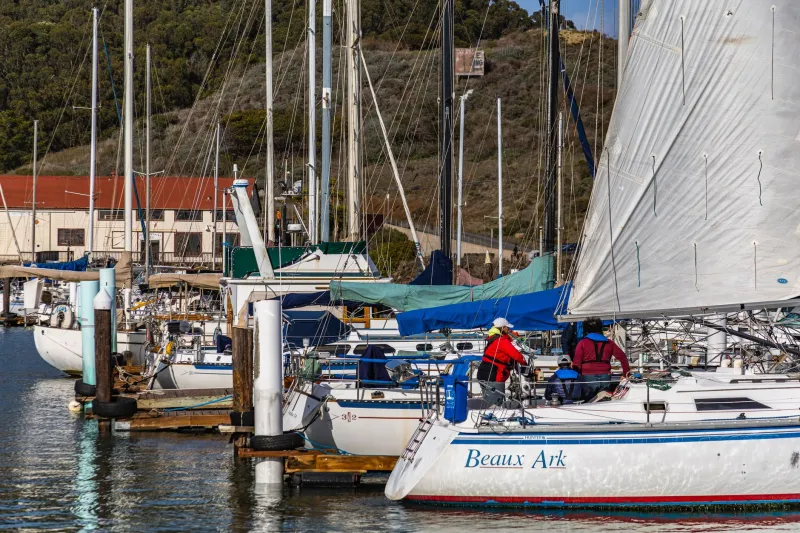
"Cleating off" means securing a line to a cleat — those T-shaped metal fittings on docks and boats. The cleat hitch is the knot used to do it. If you're helping dock a vessel and someone tosses you a line, wrapping it in a figure-eight pattern around the cleat is what they're expecting. Do it right and you'll get a nod of approval from the captain. Do it wrong and you'll hear about it.
Wind Talk: The Language of Sailing Conditions
Sailors are obsessed with wind, and Montauk sailors are no exception. True wind is the actual wind speed and direction — what you'd feel standing still on shore. Apparent wind is what you feel while the boat is moving, a combination of true wind and the boat's own forward motion. Your sails are trimmed to apparent wind, which is why the wind seems to shift when the boat accelerates.
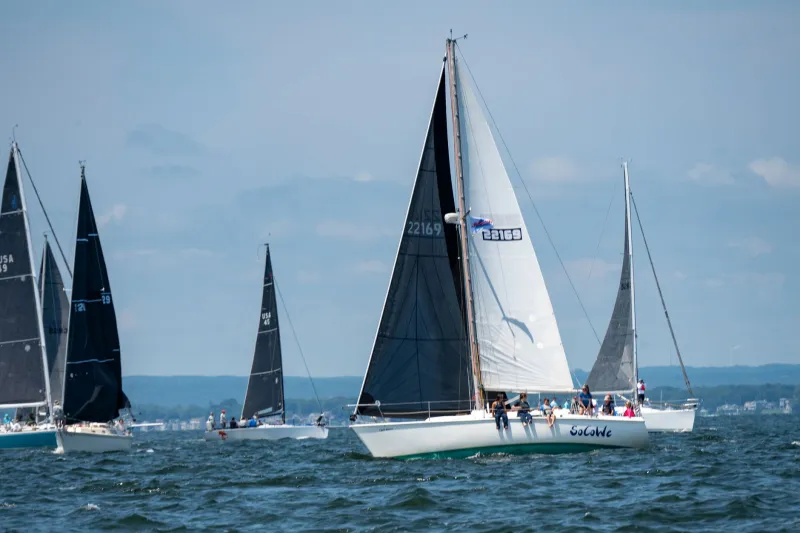
When someone says the wind is "on the nose," the wind is coming directly from the direction you want to go. You can't sail directly into the wind, so you tack — zigzag upwind in a series of diagonal legs. Coming about or tacking means the bow swings through the wind and the sails shift to the other side. Jibing is the downwind equivalent, where the stern passes through the wind. A controlled jibe is fine. An accidental jibe — boom swinging hard across the cockpit without warning — is how people get hurt. You'll hear "ready to jibe?" called out before any intentional maneuver.
"Puffs" are temporary increases in wind speed, visible on the water as darker patches of rippled surface. Montauk sailors scan for them constantly, especially in the afternoon when sea breezes build. A good puff at the right moment can add a knot of speed. A surprise puff on an overpowered boat is a different story.
Dock Culture and Local Shorthand
Beyond the technical vocabulary, Montauk's harbor has its own informal dialect. "Sundowner" doesn't just refer to the evening breeze — it's also the unofficial happy hour ritual at the dock when boats return and crews debrief. "Blow" is shorthand for a windy day, as in "it's supposed to blow tomorrow." "Lay day" is a day when conditions are too rough to go out, named after the old racing term for a non-racing day.
If someone calls your boat "tender," they don't mean it's delicate — they mean it heels (leans) easily in a breeze. "Stiff" is the opposite: a boat that resists heeling. And if a local says a spot is "well-found," they mean it's properly equipped and maintained — the highest compliment a working harbor community can pay.
The Bottom Line
You don't need to master every term before your first sail out of Montauk. But knowing the difference between your bow and your stern, understanding what someone means when they warn about the rip, and being able to cleat off a dock line without fumbling — that's enough to earn a little respect on the water. The rest you'll pick up by watching, listening, and asking questions. Sailors, as a rule, love to talk about sailing. Give them an opening and they'll teach you more in an afternoon than any glossary ever could.